
Borders rugby history book out to make peace with past
Their only wrongdoing might have been to try to earn a living from playing the sport they loved, but for decades Borderers heading south of Hadrian’s Wall to join English rugby league teams were branded as outcasts and banned from returning to the clubs they learned their trade at.
That ban was lifted over 30 years ago but the gulf between rugby union and its 13-a-side opposite number wasn’t bridged overnight and bygones becoming bygones was far from an instant process.

The times they are a-changing, however, and following this summer seeing rugby league fixtures played at Hawick’s Mansfield Park and Earlston hosting new rugby league outfit Border Barbarians, Kelso have become the latest club to make peace with their past and put years of division behind them.
The Poynder Park side made that milestone move on Sunday, using the launch of a book and whisky celebrating their 150th anniversary to officially recognise the contribution of past players they now regard as forgotten heroes rather than renegades to be shunned for turning their backs on the union code.
That new book – written by David Ferguson and David Welsh, designed by Wayne Lawrence and printed by Jedburgh’s Footeprint – adds to the centenary club history produced by former player, coach and president Arthur Hastie back in 1976.
As well as looking back at the development of sport in Kelso, the near loss of Poynder Park and the first unofficial championship of 1947-48, the book features interviews with Kelso’s surviving British and Irish Lions, internationalists and other legends of the sport including Jim Telfer, Jim Renwick, Andy Irvine, Gregor Townsend and Gareth Edwards, talking about their connections to, and memories of, Kelso.
At its heart is also the hitherto-untold story of players produced by the club who went on to throw their lots in with rugby league, leading to a century-long division between those playing amateur rugby union and those lured away by its professional counterpart, with the Scottish Rugby Union and their English, Irish and Welsh opposite numbers issuing lifelong bans to all such players, a sanction only ended in 1995 when union itself turned professional too.
Many legends of the game, including Scotland internationals, headed south from Hawick, Selkirk, Jed-Forest, Gala, Kelso and other clubs from the late 1900s onwards to take up full-time jobs in the north of England and earn match bonuses for playing at weekends.
Such code-breakers were cast out from the union game, and even upon returning to the Borders they were denied admission to their old clubs and prevented from playing rugby with former teammates.
Explaining Kelso’s bid to put past differences behind them once and for all, club president Adam Marshall said: “We felt that this was a good opportunity to mark the change in times and recognise and celebrate these players from our past.
“Our book-writers David Ferguson and David Welsh have done a wonderful job in telling the stories of guys like Charlie Robeson, who left in 1913 to play league at Oldham and then fought at the Somme and Passchendaele, among other horrendous World War One battles, yet returned home to Kelso banned from playing rugby. It’s hard to get your head around that.
“George ‘Hap’ Wilson won the unofficial Scottish championship with Kelso, was a paratrooper in World War Two and went south and won rugby league’s challenge cup final in front of 72,000 supporters at Wembley, as well as playing for Great Britain.
“George Fairbairn was simply one of the greatest players in union and league of the 1970s full stop. Andy Irvine’s story on George is fascinating.
“We are perhaps fortunate that one of our and Scotland’s greatest players, Alan Tait, had a great career in league and back in union after union turned pro in 1995, and that probably has helped our club move on.
“We felt it was important that we did something official to celebrate these forgotten heroes of Kelso.
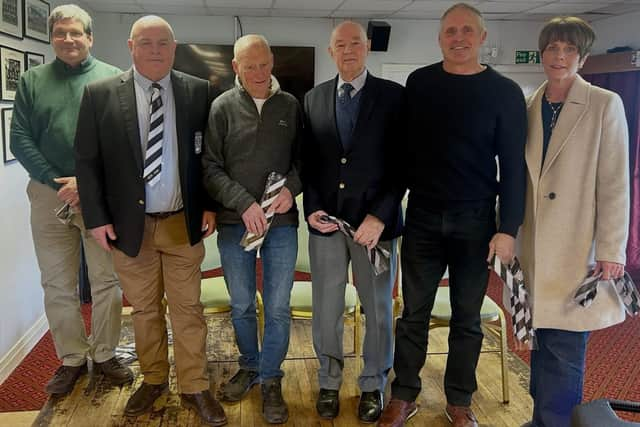
“It was wonderful to have George Swanston, now 84, and his wife with us at Sunday’s book event, as well as Charlie Robeson’s grandson Derek, Ged Tait’s son Mike and Alan Tait and his sister Jacqueline, receiving a commemorative tie in honour of their father, Alan senior, as well as Alan himself, and we will also present them to other families who couldn’t make the event.
“These men were all Kelso players who we’re extremely proud of.
“They take their place in this fantastic book among our British Lions, our club heroes, Harlequins and stalwarts of the club behind the scenes, and they and their families will always be welcome in our club.”
Kelso’s 150th anniversary book, priced £35, can be ordered online via the club website, https://www.kelsorfc.co.uk/