
New book sheds fresh light on life of Borders sports broadcasting legend Bill McLaren
Though known worldwide as the voice of rugby, it would be more accurate to describe Hawick’s late Bill McLaren as the voices – plural – of the sport he devoted his life to teaching and commentating upon, a new book reveals.
Former entrepreneur and academic turned author Murray Watson has written the first biography of the late sports commentator to add to the two autobiographies McLaren saw published during his lifetime, 1991’s Talking of Rugby: An Autobiography and 2004’s The Voice of Rugby: My Autobiography.
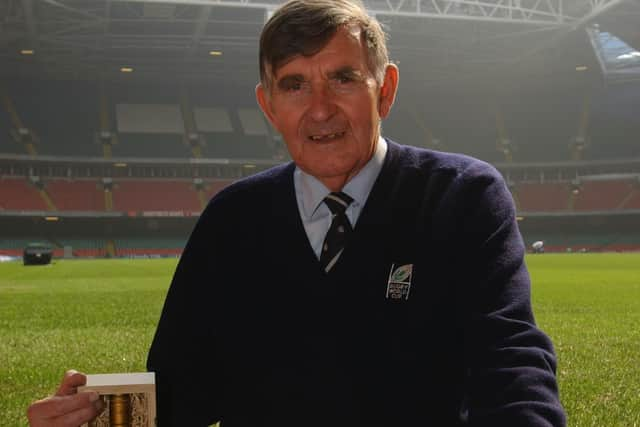

So definitive were those life stories straight from the horse’s mouth that no third parties have taken it upon themselves to offer a different perspective in the 22 years since the most recent of them came out – until now.
Watson, also of Hawick, knew McLaren for decades, from his childhood until the broadcaster’s death in 2010 at the age of 86, and spent years archiving his various papers for digitisation for the benefit of sports researchers of the future to create an exhibition first seen at Hawick Museum in 2023 and 2024 but since relocated to Edinburgh’s Murrayfield Stadium, and he’s now put the knowledge and insight he gleaned from that long-term labour of love to further good use to tell his fellow Borderer’s life story.
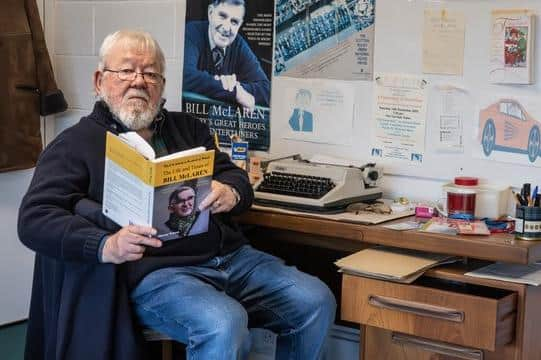
The 78-year-old’s book, The Life and Times of Bill McLaren: They’ll Be Dancing in the Streets of Hawick, is out now and he’s confident it will shed new light on McLaren’s life, even in the cases of those closest to him, including the fact that the voice of the voice of rugby familiar to television viewers all over the world wasn’t always the same as the one heard by those watching the sport alongside him at his home-town’s Mansfield Park or the children he taught physical education to at Hawick High and its feeder primary schools.
“There are lots of new stories about Bill, so many that Linda Lawson, his daughter, kept telling me she was learning new things about her dad,” Watson told us.
“Here’s one example – I discovered that Bill won an elocution competition in Galashiels in the mid-1930s.
“His mother sent him to elocution lessons, and that served him in good stead because when he began his radio commentary career in 1952, the BBC expected their broadcasters to speak with a received-pronunciation English accent.
“While Bill did not speak with a posh English accent, he was a definitely more Morningside than Hawick, so the voice of rugby, in fact, had more than one voice.”
His new 252-page book, Murray’s fourth, its predecessors including 2023’s Voices of Hawick Rugby, took him the best part of two years to write.
“In terms of sitting down at my keyboard and proofreading, it would have been 14 months that it took to put together, but that would be misleading as much of the research was done beforehand,” he said.
“In 2017, the Bill McLaren Foundation asked me to assemble and catalogue everything that Bill had left in his chaotic study at Hillersden. I did that for a few mornings a week and finished just before covid struck.
“I filled 117 archive boxes with materials, and to give an idea of scale, that compares with the archive left by the playwright Alan Bennett.
“Bill’s archive boxes were taken into Hawick Heritage Hub and then on to Stirling University, where they have a state-of-the-art digitisation studio.
“Digitisation and content management system work is ongoing and the National Library of Scotland have deemed it a collection of national importance.
“Digitisation made it much easier for me to sort, analyse and bring up documents on my screen to examine without having to travel to an archive.
“There were also other benefits that made for faster writing. One was a beta artificial intelligence program that read handwritten letters, which were very often illegible or hard to read, and translated them into helvetica.
“One significant thing about Bill’s archive is that it will be one of the last purely paper-based collections. In future, archival collections will also comprise data in one electronic format or another and they will be much more difficult to read than a paper document – for example, who can read an old floppy disk or password-protected WhatsApp?”
Deciphering McLaren’s often-incomprehensible scrawl wasn’t the only part AI played in the production of Murray’s book either as he believes his subject’s approach to compiling facts and figures could be considered a non-artificial precursor to the technology currently changing the world, saying: “My book analyses what made Bill’s commentaries and journalism special – his forensic attention to detail and his multifaceted methodology for collecting, storing and retrieving data in his chaotic study.
“To enrich his commentaries, Bill developed his version of spreadsheets long before computerised versions came into common use, and arguably Bill’s big sheets operated through his unique cognitive approach, a form of pre-digital artificial Intelligence.”
Murray’s book, featuring a foreword by 51-times-capped former Scotland full-back Andy Irvine, is out now and its publication will be followed by a launch event, open to all, at Mansfield Park next Friday, October 30, from 7.30pm.
Produced by London-based Grosvenor House Publishing, it costs £25 in hardcover and £15.50 in paperback.