
Grand slam won by Tony Stanger try named as one of most memorable moments in 100-year history of Edinburgh’s Murrayfield Stadium
The final whistle blowing following Borderer Tony Stanger’s 1990 Five Nations Championship-winning try for Scotland has been named as one of the three most memorable moments in the 100-year history of Edinburgh’s Murrayfield Stadium.
That second-half try by the Hawick winger, now 57, and three first-half penalties kicked by Melrose’s Craig Chalmers secured a t13-7 win against England and a third grand slam for Scotland, following victories by 13-9 in Wales earlier that March and 21-0 hosting France and 13-10 away to Ireland the month prior.
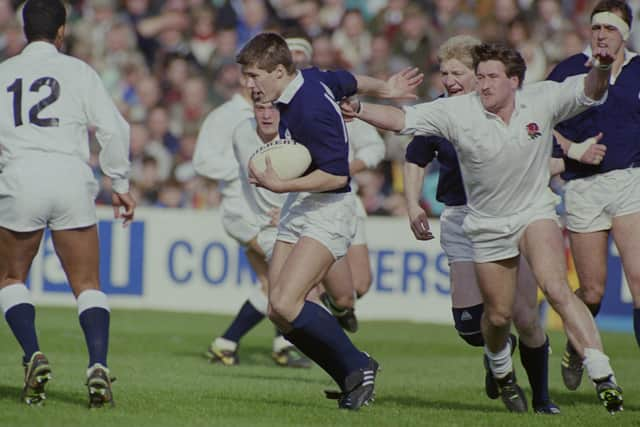

That’s their last grand slam to date and second-last championship, with a 14th title following in 1999 but none since.
Stanger’s try was one of 24 he scored for his country between 1989 and 1999, a joint record at the time, matching Ian Smith’s like tally between 1924 and 1933, only overtaken by fellow ex-Green Stuart Hogg in 2021 and since then by another ex-Mansfield Park player, Darcy Graham, and his Edinburgh teammate Duhan van der Merwe, both currently on 34.
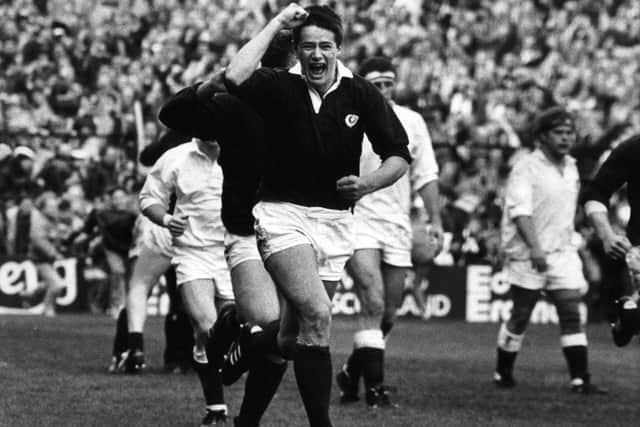
Alongside Stanger and Chalmers in that day’s Scotland team were fellow Borders players Iwan Tukalo, Gary Armstrong, Finlay Calder and John Jeffrey.
That game 35 years ago is on a shortlist of three memorable moments selected from hundreds of nominations by rugby fans by Scotland’s head coach at the time, Ian McGeechan, along with fellow former internationalists Chris Paterson and Mike Blair and ex-Scottish Rugby Union president Dee Bradbury.
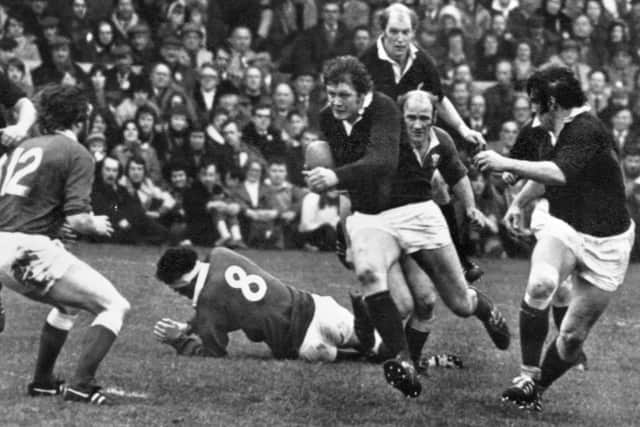
Their other choices were late Melrose lock Doddie Weir’s delivery of the match-ball for Scotland’s 22-17 loss to New Zealand in November 2017 and the national team’s 12-10 win against Wales in March 1975 in front of a crowd estimated to have been between 104,000 and 130,000.
Recalling his country’s 1990 Calcutta Cup win, Gala’s Paterson, capped 109 times between 1999 and 2011, said: “It has to be in. That’s the moment in my lifetime, the last time we won a grand slam, with so many iconic memories – the walk-out, Tony Stanger’s try, Scott Hastings’ tackle on Rory Underwood.

“It was pure theatre, and linked to arguably Scotland’s greatest success.”
Blair, capped 85 times between 2002 and 2012, said: “I must have watched that video a hundred times. It’s the final whistle that always gets me.”
McGeechan, in charge of the national team from 1988 to 1993 and 2000 to 2003, said: “I was coach that day and it still sends shivers down my spine just thinking about it.
“The atmosphere was spectacular. The supporters cheered every lineout, every kick, every tackle as if we’d scored.
“There was a completeness about it – the team, the crowd, the moment – and the reaction to the final whistle was truly unbelievable. I still get shivers thinking about it.
“Bill McLaren said he couldn’t speak at the end of the game. There was a 30-second silence on television. Hearing that, it hit me that this was different.”
Bradbury, president of the SRU from 2018 to 2020, added: “It still gives me goosebumps and makes me very proud to be a Scot.
“Pure passion, precision and pride made that win electric.”
Weir’s match-ball delivery eight years ago in front of 67,000 spectators – accompanied by his sons Hamish, Angus and Ben – followed his diagnosis with motor neurone disease just short of 12 months prior.
Among those playing for head coach Gregor Townsend’s team were fellow Borderers Hogg, 33, and Lee Jones.
Paterson, 47, recalled: “I was commentating that day and had never experienced anything like it.
“Yes, it was planned, but the outpouring of emotion, appreciation, camaraderie and love for the man was incredible.
“It wasn’t just a rugby moment – it was a huge moment in the stadium’s history and a very human one. I’ll never forget it. The response from the public was extraordinary.”
The turnout for Scotland’s win against the Welsh 50 years ago is reckoned to have been the world’s biggest ever for a rugby match, though the official figure of 104,000 was overtaken by the 109,874 fans watching New Zealand’s 39-35 victory away to Australia in Sydney in July 2000.
Hawick’s Jim Renwick and Colin Telfer were among those playing for head coach Bill Dickinson’s hosts.
McGeechan, 79, explained: “In those days, you just turned up, bought your ticket, and walked in. There was no pre-booking.
“The SRU never accepted it was 130,000 but it was. People were worried about the numbers. You couldn’t imagine it now, but it was incredible to witness.
“I was playing that day, and one of the most enduring memories were the schoolboys sitting along the touchline, all in their uniforms, as was the style.
“We stopped Wales winning a grand slam. You remember the way you felt, not just what happened. You see just how much something can have such an impact on you.”
Paterson said: “The world record is part of Murrayfield folklore.
“It’s that Scottish occasion that everyone says they were at. My mum and dad claimed it, and my dad says his feet never touched the ground as they left the ground, carried by the body of the crowd.
“I’ve never played in front of a crowd of that size, but I’ve played in front of big crowds. I always tried to block them out, but it must’ve been impossible that day.”
Fans have until 5pm today, November 10, to vote for their favourite Murrayfield moment online at https://scottishrugby.org/murrayfieldmemories/, and the winning occasion will be announced ahead of Scotland’s game at home to Argentina on Sunday, November 16, with kick-off at 3.10pm.
Graham Law, Scottish Rugby’s head of stakeholder engagement and convener of the panel, added: “Trying to pick one defining Murrayfield rugby moment from a century of history is almost impossible, and we certainly found picking a shortlist tough.
“The incredible response to the Murrayfield memories campaign shows just how much this stadium means to people across Scotland and how deeply all these moments live on in our memories.
“We’ve loved hearing the stories and reliving the drama, and now it’s over to fans to have their say on which moment deserves to be crowned the greatest of them all.”