
Borders rugby legend Doddie Weir’s 2017 match-ball handover voted most memorable moment in 100-year history of Edinburgh’s Murrayfield Stadium
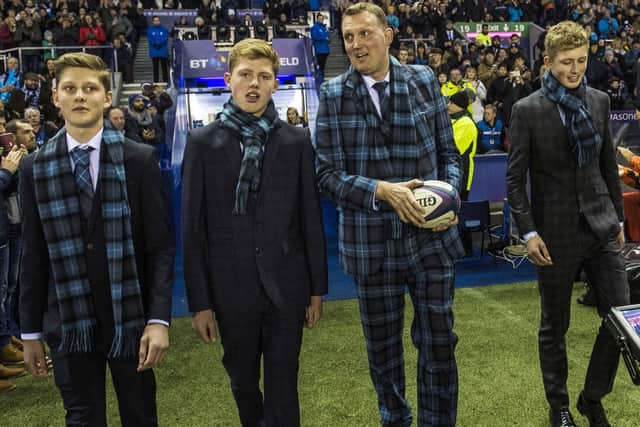
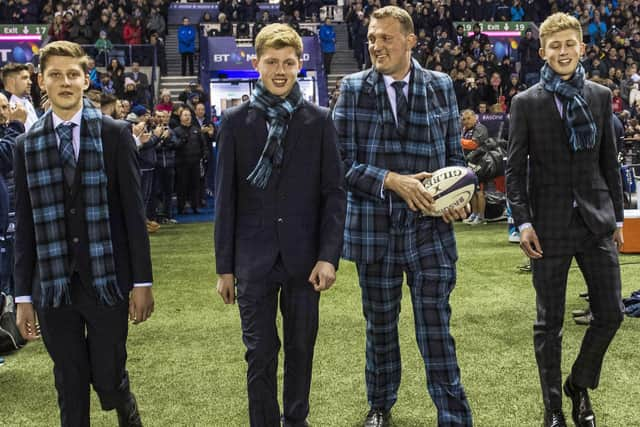
Borders rugby legend Doddie Weir’s handover of the match-ball for Scotland’s 22-17 loss to New Zealand in November 2017 has been voted the most memorable moment in the century-long history of Edinburgh’s Murrayfield Stadium.
That was as close as the national team have got to a first win ever against the All Blacks since a 21-18 away defeat at Auckland’s Eden Park in November 1990, but that’s not why it’s remembered so fondly by fans.
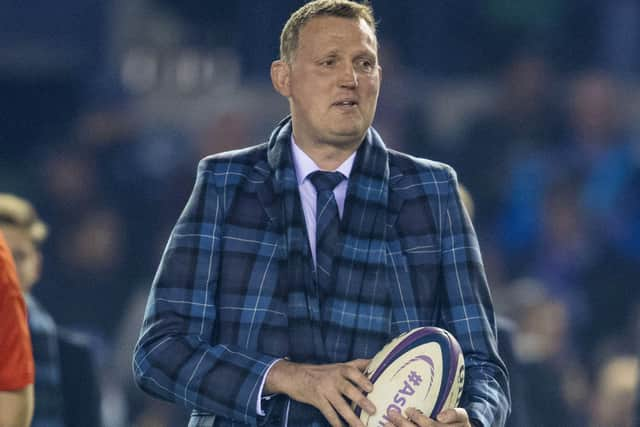

What earns its place at the top of the leaderboard of memorable moments witnessed at Murrayfield over the last 100 years was the opportunity it offered the 67,533 spectators present to show their support for the former Melrose lock almost a year on from his diagnosis with motor neurone disease and five years ahead of the incurable condition ending his life at the age of 52.
Weir’s ball delivery – accompanied by his sons Hamish, Angus and Ben – was one of three memorable moments shortlisted by a panel including Gala rugby legend Chris Paterson – along with fellow former Scottish internationals Ian McGeechan and Mike Blair and ex-Scottish Rugby Union president Dee Bradbury – for an online poll to mark the stadium’s centenary, with thousands of fans casting votes.
The others were March 1990’s 13-7 win against England, earning them their last grand slam to date, and their 12-10 victory versus Wales in March 1975, believed to have been watched by a crowd of more than 130,000, though the official attendance figure is 104,000.
Weir’s ball handover eight years ago took 54.5% of the vote, with the Scots’ Five Nations decider 27 years prior, thanks to a try by Hawick’s Tony Stanger and three penalties kicked by Melrose’s Craig Chalmers, second on 42.8% and their win against the Welsh half a century ago well behind on 2.7%.
Recalling the welcome given to 61-times-capped Weir as he walked out onto Murrayfield’s turf that night, McGeechan, 79, involved in the two other moments shortlisted as Scotland’s head coach for their 1990 grand slam victory and as player against Wales 15 years earlier, said: “There was a moment when they walked out and everything went silent, then there was the response from the stadium, the supporters – it was bigger than rugby.
“Knowing Doddie as a player, a friend, and a family man, that silence and respect said everything.
“Players, people and all the game brings providing such a response to what he and his family were going through, it surprised even Doddie.”
Paterson, 47, capped 109 times between 1999 and 2011, said: “I was commentating that day and had never experienced anything like it.
“Yes, it was planned, but the outpouring of emotion, appreciation, camaraderie and love for the man was incredible.
“It wasn’t just a rugby moment – it was a huge moment in the stadium’s history and a very human one. I’ll never forget it.
“The response from the public was extraordinary.”
Blair, 44, capped 85 times between 2002 and 2012, said: “I was assistant coach, standing on the pitch and helping to deliver water, and I was bawling my eyes out. Everybody was.
“It’s fair to say the emotion overwhelmed everyone and it probably took a lot of people’s focus. You could feel the emotion ripple around the stadium.
“Everyone was thinking of Doddie, his family and their own loved ones.
“It was a strange start to a game but a truly special one.”
Bradbury, SRU president from 2018 to 2020, added: “I was very privileged to be in the stand when Doddie and his fine boys took to the pitch.
“The roar when he walked onto that pitch was deafening.
“People were sobbing, the players on the pitch were wiping tears from their eyes and Doddie was clearly very moved by everyone’s support.
“It was just magical and humbling.”
2017’s ball delivery by Blainslie’s Weir also marked the launch of the My Name’5 Doddie Foundation and his charity has since raised almost £20m for MND research.
Telling of her pride at that night being voted Murrayfield’s most memorable of all time, his widow Kathy said: “Doddie had the honour of wearing the thistle at Murrayfield and winning 35 of his 61 caps there for the national team.
“He also played in the inaugural Rugby World Cup Sevens there in 1993, so Murrayfield will always be a truly special place for us.
“That was underlined too when Doddie had retired as a player. He loved mixing with people and leapt at the chance to meet folk and have a right laugh as he hosted hospitality at the stadium for many years.
“To hear that supporters have described the match-ball presentation he did with Hamish, Angus, and Ben before the game against New Zealand in 2017 as their favourite memory in the stadium’s 100th year is incredibly humbling.”
Weir’s eldest son Hamish, 24, said: “It reflects how people felt in that moment.
“Rugby is a sport for everyone and dad’s spirit shone far beyond the field.
“He connected with people on a human level and they loved him for that.”
Angus, 23, said: “Working with dad’s charity, we continue to strive to support those battling MND and their families and friends after they are confronted by the reality that there is currently no cure for the condition.
“When he brought the match-ball on that day, it also marked the launch of the foundation and we take great pride in what that moment began.”
Youngest brother Ben, 21, said: “Thanks to everyone who voted. I’m sure dad would be proud to know how that moment captured people’s hearts and celebrated what rugby is all about.”
Blindside flanker John Barclay was Scotland’s captain that night, leading out a starting XV including Hawick’s Stuart Hogg at full-back and Selkirk’s Lee Jones on the left wing, and he said: “Playing for Scotland is always a privilege. That day added something beyond anything I’d experienced before or after.
“You could sense the energy, the emotion, the connection between Doddie and everyone in that stadium. It’s my favourite memory of Murrayfield.”
Paul Thompson, director of fundraising for Weir’s foundation, added: “Doddie’s match-ball delivery in 2017 wasn’t just a great Murrayfield moment – it was the start of something huge.
“That day he showed the world his trademark resilience and humour, turning the toughest of diagnoses into a mission to do something about it. “It lit up Murrayfield and marked the beginning of a movement that inspired research, gave hope to people living with MND and continues to drive us forward every single day.
“We’re grateful for the rugby community’s incredible support.”