
Keeping on keeping on an achievement in itself, reckons Kelso swimmer Bronwen Payne
Participation in sport doesn’t need to yield cabinets full of silverware or international selection to be deemed a success story.
Millions of people worldwide enjoy devoting chunks of their lives to their chosen sporting activities without bringing home any medals of note, catching the eye of national team selection panels or being shortlisted for the BBC’s sports personality of the year awards, and Kelso’s Bronwen Payne is as good an example of that as any.
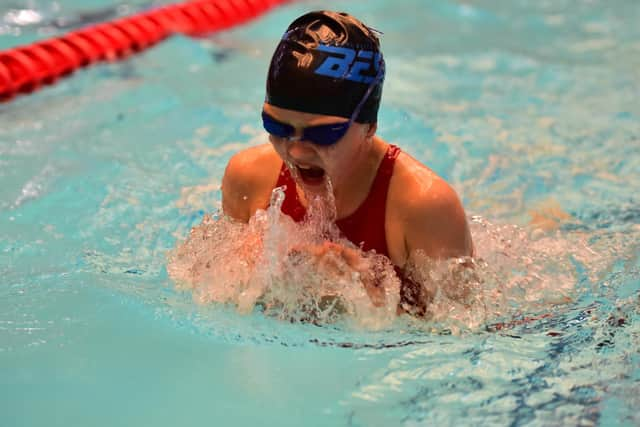

Her enthusiasm for swimming might not have made her a household name or even taken her to the Commonwealth Games or Olympics, but it’s played a leading role in her life nevertheless, proving to be a constant in teenage years that could otherwise have ended up being more challenging.
“It’s got an even bigger role in my life now,” the 18-year-old said of the sport that has been part of her daily life for over a decade.
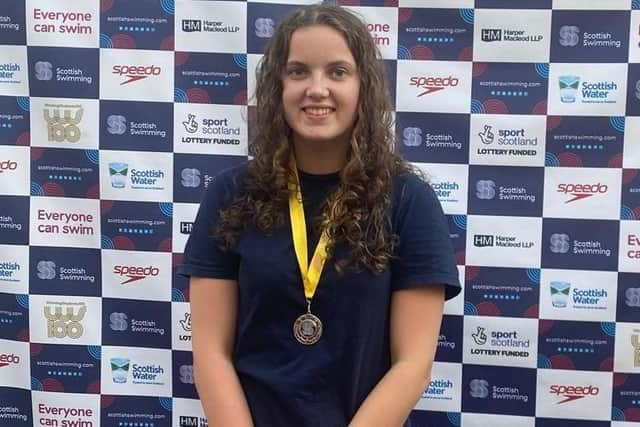
“When I was at school, I did it because I had always done it, and yes, I enjoyed it, but now I’m definitely choosing to do it and enjoying it even more.”
Born at the Borders General Hospital near Melrose and educated at Kelso’s Broomlands Primary and the town’s high school, Payne wasn’t prompted to take up swimming by any family history of achievement in the pool, but it didn’t take her long to find a role model at Kelso Amateur Swimming Club after seeing Commonwealth and Olympic swimmer Lucy Hope, of nearby Crailing, in action.
Competing from the age of ten, she joined the Borders Elite Swim Team, alias Best, at 11, coached initially by Robyn Methven and then Kirsty Armstrong, training mainly in Galashiels before coronavirus restrictions led to sessions being shifted Selkirk.
Progress was quick in arriving. Kelso and Borders meets soon gave way to east district age-group events, followed by a first Scottish national age-group relay appearance for Best in Glasgow in 2019.
Covid-19 lockdowns then robbed her of her first chances of individual national age-group competition, and worse was to follow – three bouts of the virus and a long recovery reducing her stamina just as she was looking to go up a level or two.
Payne recalled: “I couldn’t really do 200ms and 400ms anymore, and it became a mental thing after that, worrying I might run out of energy. That lasted even longer than long covid itself and made training and competing at the level I wanted to harder.”
Coaches Armstrong and her dad David helped rebuild her confidence by focusing on shorter races and, crucially, on enjoyment rather than the clock.
It’s an all too familiar story in sport and more so for girls than boys.
There are lots of reasons why children give up sport as teenagers, but the UK in general and Scotland in particular have higher drop-out rates than most European countries, and more girls quit than boys, creating a gebnder gap of about 10% by the age of 18.
Payne admits she felt drawn away from sport in her earlier teens, especially in the midst of exam-laden school years such as S5 and S6.
“I began to question how much I still wanted to swim alongside focusing on my school subjects,” she admitted.
“I definitely had doubts about it, especially when picking universities.
“I thought about Stirling because of the swimming programmes there but settled on Edinburgh – I’m studying biological sciences – because I felt it offered me the best of both worlds.
“University gave me a social side I hadn’t had, but what I maybe didn’t expect was that it actually made me enjoy swimming more.
“I now train around lectures with the university swim team and my times have been quite good despite me spending less time in the water.”
Payne has since qualified for first-time finals at both national short-course championships and the Scottish open, made her debut in British Universities and Colleges Sport competition and claimed a fourth place for breaststroke at east district level.
A key factor behind that continued sporting participation, she says, has been support from Scottish Borders Council’s athlete support programme.
“That has been really useful when I’m home from uni,” she said. “I’ve used it to get free access to lane-swimming and the gym.
“Especially as a student, it makes it much easier to come down and train, and it means I’m more inclined to actually do it.”
Her next target is a first British championships qualifying time, having missed out by half a second at 50m backstroke last year.
She credits a wide support network for keeping her there to chase such goals, following her to galas as far afield as Sunderland, Manchester and Aberdeen – coaches past and present at Kelso and Best and her dad and mum, one of the Borders’ few qualified timekeepers and officials.
Whatever times the future brings, though, Payne rates staying in a sport that many of her peers have walked away from as being an achievement in itself.
“I’ve seen a lot of people and friends stop swimming over the years and there is quite a pull to just move on, but I’m glad I stuck with it because it has given me something away from school or uni to focus on, and lots of friendships, and now I just want to enjoy it for as a long as I can,” she said.