
Government refutes ‘snub’ claims over Borders renewable energy meeting
The Scottish Government has refuted a claim it is snubbing a meeting in the Borders this weekend at which a call for a halt to all onshore renewable energy projects is expected.
Representatives of over 50 South of Scotland community councils, plus delegates from the Highlands and North East Scotland, will gather at Jedburgh Town Hall on Saturday.
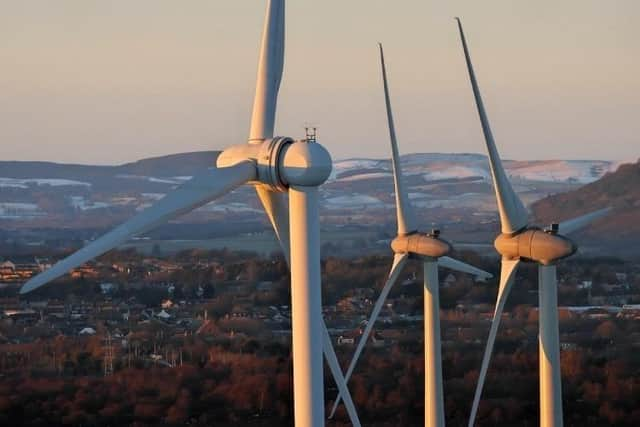

They are set to approve a demand that all pending onshore projects should be paused while the Scottish Government’s controversial National Planning Framework 4 (NPF4) policy is reviewed.
An invitation was extended to First Minister John Swinney and all other party leaders, with the option of sending a representative, but it is understood no SNP MSPs or MPs are due to attend.

Other parties are sending prospective election candidates and constituency MP John Lamont and MSP Rachel Hamilton, both Conservatives, will be there.
Convention organiser Bob Hope, who chairs the Leitholm, Eccles and Birgham Community Council, said: “With more wind turbines, battery energy storage systems and grid pylons in the pipeline, we are facing the industrialisation and destruction of rural Scotland as we know it.
“We are besieged by aggressive energy companies and it would be quite disgraceful if the Scottish Government was unable to send a senior representative to hear our concerns first hand.
“They might think they have heard the arguments before, but in an election year they should want to witness the depth of feeling in our communities, not run away from it.
“This will be the biggest single gathering of Scotland’s rural communities and I would have thought it was important for elected politicians to be there, but as it stands the convention is being snubbed by the Scottish Government.”
But a Scottish Government spokesperson has said it would not be appropriate for ministers to attend meetings to discuss live or upcoming applications that could then come before them to determine.
They say that do so could create the perception of prejudging matters and therefore risks breaching the Ministerial Code.
Meanwhile, the Government is consulting on increasing the current threshold of 50MW for onshore electricity generating stations to be considered by local authorities.
The consultation will run until March 27 this year and stakeholders are being encouraged to share their views.
Energy Secretary Gillian Martin has defended the government’s approach, saying: “Renewable energy is set to further turbo-charge the economy of Scotland, and will provide many more jobs for the communities across the country as well as wider infrastructure benefits.
“The renewables industry also has a large positive impact on the domestic supply chain which includes many businesses based in Scotland. Increased generation of renewable energy is critical to the energy security of the country, and have the potential to reduce our reliance of fossil fuels and the price volatility they come with.
“Potential impacts on communities, nature and cultural heritage, including the cumulative effects of developments, are important considerations in the decision-making process for developments. All applications are subject to site-specific assessments.
“It is also vital that communities see direct benefits from developments, including through shared ownership and community benefit schemes.
“The power to mandate is reserved to the UK Government, leaving Scotland reliant on a voluntary arrangements under our Good Practice Principles, and that’s why I have been pressing successive UK Governments to mandate community benefits from mature onshore renewables.”
Concerns focus on the way NPF4 Policy 11 is being implemented, which stipulates that “significant weight will be placed on the contribution of the proposal to renewable energy generation targets and on greenhouse gas emissions reduction targets”.
There is also a call for the 50 megawatts threshold at which plans are referred for approval to the Scottish Government’s secretive Energy Consents Unit (ECU) to be raised to 100mw, to give local authorities more control.
Several projects have been approved by the ECU and rubber stamped by ministers despite objections from local planning committees.
Mr Hope added: “What we are seeing is the Scottish Government riding roughshod over our communities in which none of the arguments against inappropriate projects can succeed because of the dogmatic presumption in favour of approval no matter what.
“It has got to stop before any more damage is done to our landscape and heritage, and on Saturday I hope we can send a clear and united message to the Scottish Government that enough is enough.”
The meeting at Jedburgh Town Hall starts at 2pm on Saturday, January 17, and is expected to finish around 4pm.
Borders Wind Farm Watch is a cross-community initiative of individuals, groups and businesses which monitors wind farm development in the Scottish Borders.