
A college at the edge – Why Stranraer exposes the fragility of Rural Education Funding
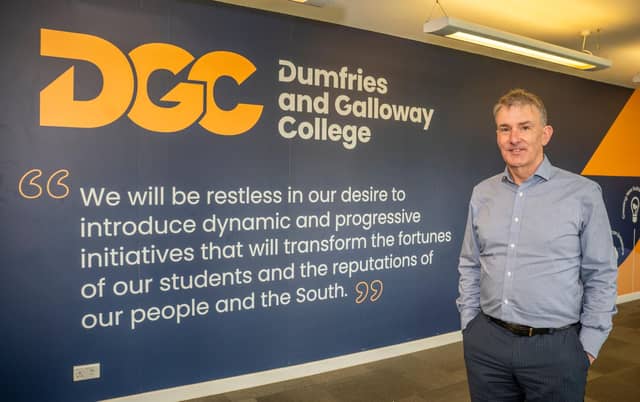

By Douglas Dickson, CEO and Principal, Dumfries and Galloway College
Seventy‑five miles west of Dumfries, on the road to the Irish Sea, the Stranraer campus of Dumfries and Galloway College serves a town of about 13,000 people at the far edge of one of Scotland’s largest council areas. It is exactly the kind of place that can slip out of view when national policy talks in big numbers and averages. Small populations, long journeys, patchy transport and complex local economies do not fit neatly into standard spreadsheets.
Stranraer is not a quirky outlier in Scotland’s college system; it is a warning light on the dashboard. It shows what happens when a funding and performance model that talks about “place” and “equity” still mostly rewards size, volume and proximity.
When distance becomes disadvantage
Most college performance measures are built around an urban mindset. The more courses you run, the broader your offer, the more students you put through the system, the better you look. That might seem reasonable in a city with strong transport links and large catchment areas, but it does not translate well to a region where campuses are nearly 80 miles apart.
Dumfries and Galloway College has one campus in Dumfries, serving a town of around 50,000, and another in Stranraer, serving a quarter of that, with journeys between them taking up to an hour and a half. Those differences are not details; they shape which courses are viable, how staff can be deployed and what it costs to keep the doors open. In that context, distance itself becomes a form of inequality if funding and accountability systems do not adjust for it.
When that happens, course choice narrows first in smaller places, and communities are quietly told to do more of the adapting themselves. That is not a conscious political decision, but it is the practical outcome of how the system currently works.
What a campus actually does in a town like Stranraer
Stranraer’s Place Plan talks about regeneration, new opportunities and giving people reasons to stay and build their lives locally. A college campus is one of the few institutions that can help on all those fronts at once: it trains people, supports employers and gives young people visible routes into work or further study without having to leave immediately.
Yet under the current model, small rural campuses are often treated more like cost lines than civic anchors. The Scottish Funding Council still allocates most teaching money on a volume basis, with only partial recognition of the fixed costs and extra effort involved in delivering in rural regions. Short‑term boosts for rural provision, followed by cuts or redistribution, make it harder to plan sensibly over more than a year or two.
At Stranraer, the response has been to stop pretending the campus can ever mirror an urban one and instead to double down on what matters locally. Provision has been reshaped around areas that directly match local and regional need: sustainable construction, hospitality, care, hair and beauty and engineering routes that have been developed with local employers. The return of a joinery apprenticeship after more than a decade, and the arrival of Project SEARCH for young people with disabilities, are good examples of a campus reconnecting with its labour market and community.
This is not about quietly shrinking. It is about making choices that fit the town, rather than chasing headline numbers that were designed for somewhere else.
Digital helps, but it is not the whole answer
Digital learning has made a real difference, but not in the way it is sometimes described. In rural Scotland, online delivery is less about convenience and more about fairness.
For school pupils in outlying areas, online senior‑phase courses can open doors that geography would otherwise shut. For adults, flexible online programmes mean they can retrain or upskill without uprooting families or giving up local jobs. Employers can be involved in assessment and project work even when they are not near a physical campus. But none of this removes the need for a real, visible college presence in the town itself.
From outpost to local hub
Looking ahead, Stranraer’s strength will come from being more than a teaching site. Sharing the campus with organisations like Skills Development Scotland and the Better Lives Partnership is already nudging it towards a genuine local learning hub, where education, careers advice, employability support and inclusion services sit side by side.
There is plenty of scope to grow adult and community learning, short courses for reskilling and higher‑level options so that people can move further in their education without leaving the west of the region. That fits well with national aims around regional growth, rural regeneration and a just transition in areas like net zero skills.
What is missing is not ideas but alignment. If national agencies are serious about “place‑based” growth, then the way colleges are funded and judged has to catch up. Rural campuses cannot be asked to support regeneration while being funded as if distance and population size do not matter. Long‑term stability, not one‑off uplifts, is what allows thoughtful planning and partnership.
Can Scotland afford to let places like this go?
There can be no debate about the many benefits our Stranraer campus brings to the community ─ and without it the impact would reach far beyond the loss of courses. Employers would see their skills pipeline weaken. Young people would lose local routes into work or higher education. The town would lose one of the few institutions with the reach to bring together public services, voluntary groups and businesses around a shared agenda.
So the real question is not whether Scotland can afford to support small rural campuses, but whether it can afford the long‑term cost of not doing so. Stranraer may sit at the edge of the map, but if the country is serious about fairness between regions, it needs to sit much closer to the centre of how policy and funding decisions are made.