
Solving the mystery of the unknown KOSB soldier
Former Southern Reporter journalist Mark Entwistle tells how the mystery of an unidentified officer in the KOSB during the Great War was eventually solved.
With my grandfather having served with the King’s Own Scottish Borderers during the Second World War and a great uncle also serving with the regiment during the Great War, my family has always felt a strong connection to the ‘Kosbies’.

During my 29 years as a journalist on The Southern Reporter, I also penned many stories with a KOSB theme, and despite now living in Lochaber, I retain a keen interest in the KOSB and other related Borders subjects.
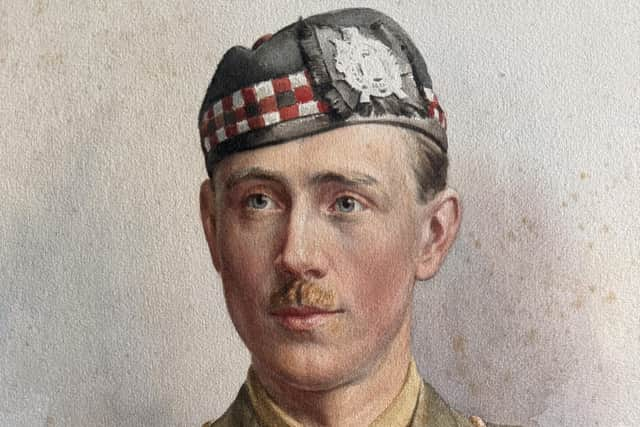
And it was that interest that led me recently to purchase a watercolour portrait of a young unidentified KOSB officer, after having spotted it on the eBay online selling platform.
The only information on the painting are the words ‘Crowe and Rodgers, Stirling', which was the name of a well-known photography business in the city, but which appears to have ceased trading some time in the 1950s.
It is possible the artist simply copied the name of the photography studio onto the portrait after using a photograph as the basis for the artwork.
There was no other information either on the painting itself or from the seller as to the soldier’s identity, and it struck me as profoundly sad that the work of art was probably once a treasured family possession, immortalising a young officer from the Borders’ local infantry regiment who may well have lost his life in the service of his country.
The portrait cost me the princely sum of just £42 from the seller, who informed me he had purchased the work from a dealer in Kettering, in Northamptonshire. It depicts the soldier in the uniform of a second lieutenant in the KOSB, complete with a diced Glengarry.
I instantly recognised the cap badge as well as the officer’s collar badges. Who was he? Did he live through the First or Second World Wars? Where did he call home? These were all questions I thought would probably never be answered.
But then I had not reckoned with the passionate enthusiasm and expertise of the online community of enthusiasts who inhabit the many forums devoted to all things military.
But my first port of call was Maestro Paul MacDonald, a Highlander who now lives in the Borders, where he runs MacDonald Armouries and a school of historical swordsmanship and fencing. He also founded a living history group specialising in Second World War combatives.
Paul kindly examined my photograph of the portrait, confirming that the subject was indeed an officer in the KOSB and that, based on the silk tie worn in the portrait, he was probably a First World War soldier.
“There’s no real difference between the British Army No.2 uniform and Sam Browne belt between WW1 and WW2, which is what he wears here,” said Paul.
“The only small detail that might provide a clue is the tie. The khaki knit tie became issue in WW2, and the painting might instead show a silk tie, which would suggest the WW1 era.”
So that was a good start, probably narrowing down the theatre of conflict to the Great War. The next step was to see if any of the specialist online forums could help.
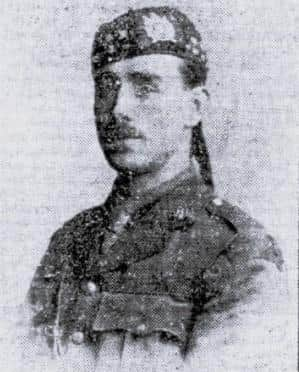
After a few weeks of various lines of enquiry being followed by various members of a KOSB forum, London-based member Nick Hubberstey tagged me into a post revealing, incredibly, that despite the scant information available, he might have actually identified the officer in the portrait, thanks to a photograph in a book and a previous thread in the Great War forum.
“If I’m right, his name is Bernard Abbott and he not only survived the war, but had an interesting military career, ending up as a Lieutenant Colonel dentist during WW2,’ Nick messaged me.
“Abbott's wartime career accords closely with the uniform period details we've discussed in the painting, and there is a clear facial resemblance in the photographs of him on the Great War thread.
“Notably, that in the Berwickshire News article of 1923, which looks to be the one on which the painting was based.”
The edition of the Berwickshire News from April 1923 records that Abbott was the son of Mr and Mrs J. H. Abbott, who lived in Berwick High Street.
He received his dental degree from the School of Medicine of the Royal Colleges in Edinburgh, and after practical training in England, finished his training under Berwick dentist Mr R. R. Riddell of Quay Wells.
Nick went on to explain that the plain arc shoulder titles shown in the painting are also of the same type used by units of the 9th Scottish Division to indicate companies within each battalion. Red would indicate A Coy, 6th KOSB.
This is the battalion Abbott served in from mid-1917 until his temporary commission ended in 1919.
“As such, the painting could date from when he was convalescing in Scotland after being wounded at Passchendaele in late 1917,” Nick added.
Early in the war, Abbott had first joined the ranks of the Argyll and Sutherland Highlanders, and it was while serving in France with the regiment’s 7th Battalion that he was badly wounded himself while carrying a wounded comrade during the carnage of the First Battle of the Somme.
Fought over five months from July, 1916 onwards, the First Battle of the Somme saw the British Army suffer the bloodiest single day in its history, with over 57,000 casualties and approximately 19,000 killed on the opening day.
Abbott later received his commission into the KOSB and was posted to the 6th battalion stationed in France and Flanders. He was wounded a second time while in Flanders at what is officially referred to as the Third Battle of Ypres, but also known as Passchendaele.
The battle became infamous, not just due to the horrendous scale of casualties, but also for the mud.
After the war, Abbott returned to his home town of Berwick-upon-Tweed and qualified as a dentist. He received the Freedom of Berwick in 1927, and, after rejoining the army, he had a long and distinguished military career retiring in 1952 as a full colonel and commandant of the Royal Army Dental Corps.
Abbott died in 1984 at the age of 89.