
Bold bid to save Selkirk’s historic statues
A brand new grant, which includes the restoration of historic high streets in the Borders, could be the answer to the years-long puzzle of how to save two of Selkirk's historic statues.
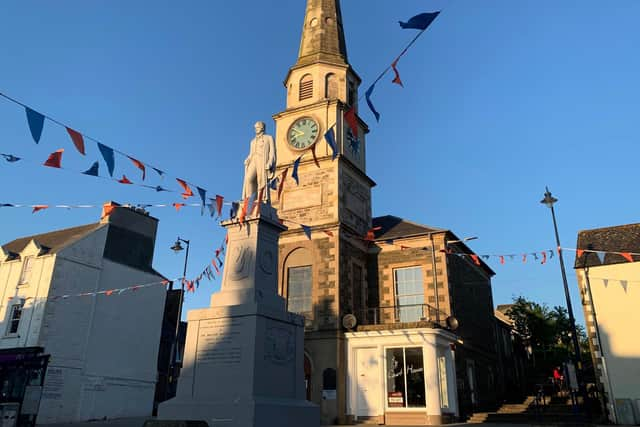
The iconic statues of Sir Walter Scott, in Selkirk’s Market Place and that of explorer Mungo Park, further along the High Street, have been threatened by decades of poor restoration, to the point where locals have been in despair. After a year-long survey and study by Selkirk‘s Stuart Davidson, a chartered architectural technologist, in collaboration with Historic Environment Scotland, a new grant may enable the restoration of the statues, if the bid for funds is granted.
Planning permission has been applied for stripping away the many years of peeling paint from the surface of the statues and returning them to the condition in which they were first created. In the case of the Mungo Park statue the bronze figurines at the base of the statue would also be restored. Selkirk-based Stuart Davidson Architecture has applied for planning permission as a first step, accompanied by detailed explanations of how the statues would be restored, alongside an expression of interest to the UK Shared Prosperity programme for 2025-26, administered by Scottish Borders Council.
Specific themes of the grant include ‘Communities & Place: Thriving Places’, which includes projects which develop the visitor economy or improve High Streets and Town Centres. Conditions of the grant include the provision that projects must be ready to begin immediately. Due to the very short timescale for delivery, there will be a single funding round which will take place in midsummer. All successful projects must be completed by the end of March 2026.

Although discussion has been had for the last two years at Selkirk’s Common Good Committee, this current initiative is being spearheaded by Scottish Borders Councillor Caroline Cochrane (Chair of Selkirk Common Good), Stuart Davidson and David Anderson (both of Selkirk Means Business), Andy Murray (Chair, Selkirk Community Council), and Viv Ross of Selkirk Regeneration.
Stuart said: ”It has taken a lot of careful and dedicated work to address all the issues that affect these statues, but it has been a labour of love, because of the meaning that these statues hold for every local person. We have assessed each element individually, focusing on the importance and the overall impact the proposed changes would have, both on the character and inherent fabric of each monument, so as to ensure that historically important elements are preserved and enhanced as part of the proposal.”
The Sir Water Scott monument, by Alexander Handyside Ritchie, dates from 1839, with later alterations in 1932 by Dick Peddie and Walker Todd. It was Category B listed by Historic Environment Scotland in 1971. Located on a double plinth, its pedestrian statue facing West commemorates the world famous author Sir Water Scott who sat as Seriff (shira) of Selkirk within the Courthouse located behind the statue from 1800-1832. Following Scott’s death in 1832, the statue was erected by the “Gentlemen of the County” after a competition, and is located on the spot of the former Tolbooth.
The Mungo Park monument, by Andrew Currie, dates from 1859, with bas reliefs from 1905 and bronze statues from 1913 by Thomas Clapperton. It was also Category B listed by Historic Environment Scotland in 1971.